Enter a math problem...
error msg
- Algebra
- Calculus
- Trigonometry
- Matrix
- Differential
- Integral
- Trigonometry
- Letters


Question
\frac{5}{\left(3b^{3}-2b^{2}-5\right)}=\frac{2}{\left(b^{3}-2\right)}
Solve the equation
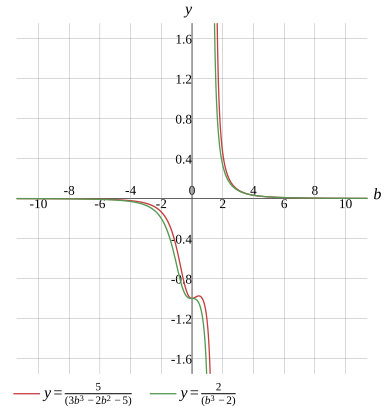
b_{1}=0,b_{2}=4
Evaluate
\frac{5}{\left(3b^{3}-2b^{2}-5\right)}=\frac{2}{\left(b^{3}-2\right)}
Find the domain
More Steps
Evaluate
\left\{ \begin{array}{l}3b^{3}-2b^{2}-5\neq 0\\b^{3}-2\neq 0\end{array}\right.
Calculate
\left\{ \begin{array}{l}b \in \mathbb{R}\\b^{3}-2\neq 0\end{array}\right.
Calculate
More Steps
Evaluate
b^{3}-2\neq 0
Move the constant to the right side
b^{3}\neq 2
\text{Take the }3\text{-th root on both sides of the equation}
\sqrt[3]{b^{3}}\neq \sqrt[3]{2}
Calculate
b\neq \sqrt[3]{2}
\left\{ \begin{array}{l}b \in \mathbb{R}\\b\neq \sqrt[3]{2}\end{array}\right.
Find the intersection
b\neq \sqrt[3]{2}
\frac{5}{\left(3b^{3}-2b^{2}-5\right)}=\frac{2}{\left(b^{3}-2\right)},b\neq \sqrt[3]{2}
Remove the parentheses
\frac{5}{3b^{3}-2b^{2}-5}=\frac{2}{b^{3}-2}
Cross multiply
5\left(b^{3}-2\right)=\left(3b^{3}-2b^{2}-5\right)\times 2
Simplify the equation
5\left(b^{3}-2\right)=2\left(3b^{3}-2b^{2}-5\right)
Calculate
More Steps
Evaluate
5\left(b^{3}-2\right)
Apply the distributive property
5b^{3}-5\times 2
Multiply the numbers
5b^{3}-10
5b^{3}-10=2\left(3b^{3}-2b^{2}-5\right)
Calculate
More Steps
Evaluate
2\left(3b^{3}-2b^{2}-5\right)
Apply the distributive property
2\times 3b^{3}-2\times 2b^{2}-2\times 5
Multiply the numbers
6b^{3}-2\times 2b^{2}-2\times 5
Multiply the numbers
6b^{3}-4b^{2}-2\times 5
Multiply the numbers
6b^{3}-4b^{2}-10
5b^{3}-10=6b^{3}-4b^{2}-10
Move the expression to the left side
5b^{3}-10-\left(6b^{3}-4b^{2}-10\right)=0
Calculate
More Steps
Add the terms
5b^{3}-10-\left(6b^{3}-4b^{2}-10\right)
If a negative sign or a subtraction symbol appears outside parentheses, remove the parentheses and change the sign of every term within the parentheses
5b^{3}-10-6b^{3}+4b^{2}+10
Subtract the terms
More Steps
Evaluate
5b^{3}-6b^{3}
Collect like terms by calculating the sum or difference of their coefficients
\left(5-6\right)b^{3}
Subtract the numbers
-b^{3}
-b^{3}-10+4b^{2}+10
Since two opposites add up to 0,remove them form the expression
-b^{3}+4b^{2}
-b^{3}+4b^{2}=0
Factor the expression
b^{2}\left(-b+4\right)=0
\text{Separate the equation into }2\text{ possible cases}
\begin{align}&b^{2}=0\\&-b+4=0\end{align}
The only way a power can be 0 is when the base equals 0
\begin{align}&b=0\\&-b+4=0\end{align}
Solve the equation
More Steps
Evaluate
-b+4=0
Move the constant to the right-hand side and change its sign
-b=0-4
Removing 0 doesn't change the value,so remove it from the expression
-b=-4
Change the signs on both sides of the equation
b=4
\begin{align}&b=0\\&b=4\end{align}
Check if the solution is in the defined range
\begin{align}&b=0\\&b=4\end{align},b\neq \sqrt[3]{2}
Find the intersection of the solution and the defined range
\begin{align}&b=0\\&b=4\end{align}
Solution
b_{1}=0,b_{2}=4
Show Solutions
Graph