Question
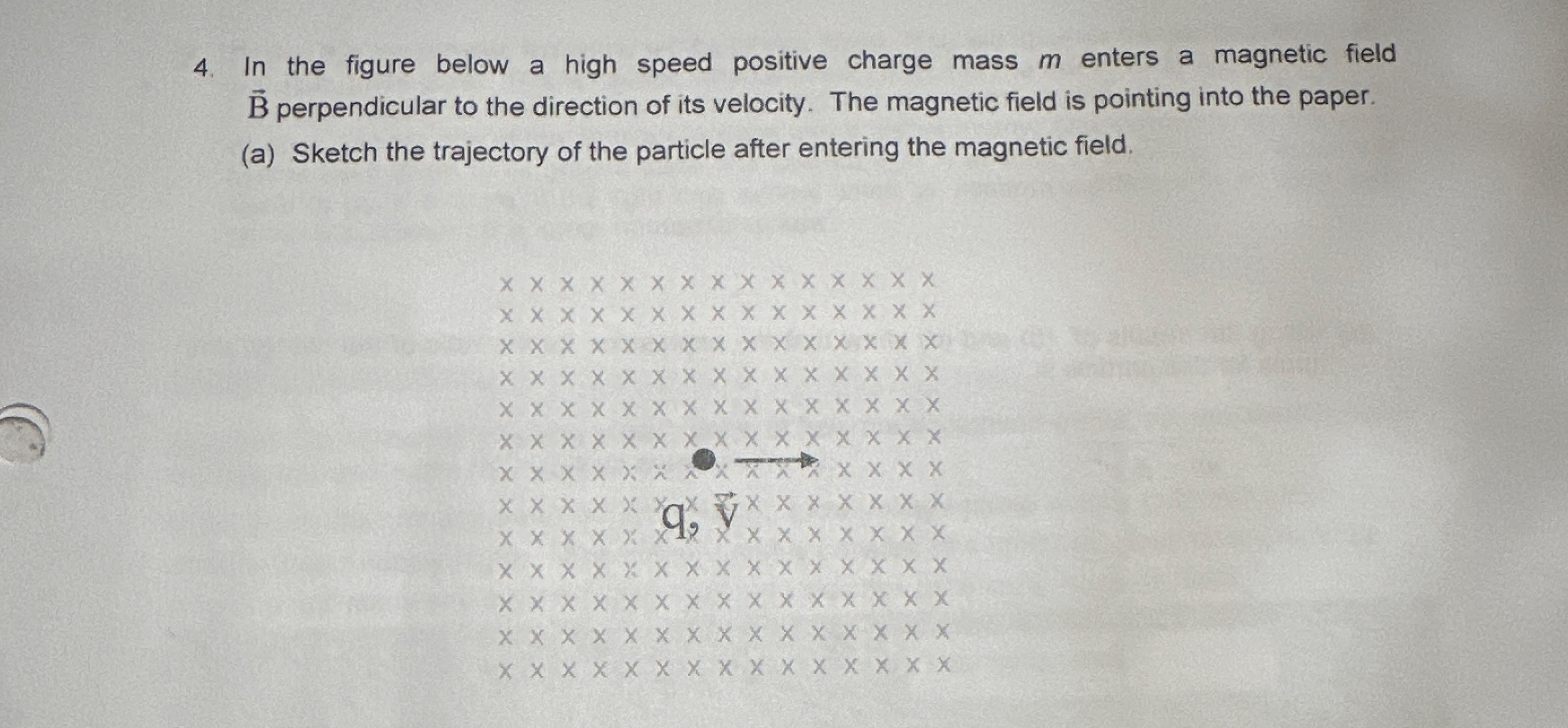
4. In the figure below a high speed positive charge mass \( m \) enters a magnetic field \( \overrightarrow { \mathrm { B} } \) perpendicular to the direction of its velocity. The magnetic field is pointing into the paper. (a) Sketch the trajectory of the particle after entering the magnetic field.
Asked by an UpStudy premium member to our live tutor.
Aug 14,2026 09:49
Real Tutor Solution
Tutor-Verified Answer
Answer
Answer for (a)
The trajectory is a circular arc bending upward, i.e. counterclockwise.

Solution
The magnetic force is upward.
Because the force is always perpendicular to the velocity, the particle moves in a circular path. Since it starts moving right and is forced upward, its path curves upward in an anticlockwise direction.
Reviewed and approved by the UpStudy tutoring team
Like
(3)
error msg
 Explain
  Simplify this solution
 Extra Insights
When a high-speed positive charge enters a magnetic field perpendicular to its velocity, it undergoes circular motion. The magnetic force acts as a centripetal force, directing the charge towards the center of its circular path. As the particle enters the field, sketch the trajectory as a circle with the particle moving in a counter-clockwise direction (assuming the positive charge goes into the field from the left). The radius of this circular path depends on the particle's velocity, charge, and the strength of the magnetic field.
The right-hand rule can help you determine the direction of the magnetic force. Point your fingers in the direction of the velocity (to the right if entering from the left), curl them in the direction of the magnetic field (into the paper), and your thumb will point in the direction of the magnetic force acting on the positive charge, which will direct it upwards, creating a circular path.
Related Questions
Una cosa di massa 50 kg si trova su un piano inclinato che formanalo lorizzontale un angolo di 30^{circ}, Cakwal il valore della forza di attrito necessaria a
mantenere in equilibrio la cassa. [0,25 kN]
Physics
Mar 14, 2025
9. Uma moto e um carro deslocam-se em sentidos opostos em uma estrada retilínea, com velocidades iguais a 72 km/h e 108 km/h, respectivamente. Se em t=0 eles estão a 1,5 km um do outro, determine:
a) o intervalo de tempo necessário para o encontro de ambos.
Physics
Mar 20, 2025
12 Un giocatore di curling lancia sul ghiaccio una
stone (pietra) di 18 kg alla velocità di 1,0 m/s.
Quanto tempo impiega la stone per fermarsi se la
forza dattrito è di 1,8 N ?
Physics
Mar 15, 2025
2.- Una bomba extrae el petróleo de un pozo a 975 m de
profundidad y lo eleva a un depósito situado a 28 m de
altura. ¿Qué nivel supera el petróleo?
Physics
Mar 12, 2025
terrestre, 1000 kin piú in alto dell'altitudine di un
satellife geostazionario (circa 36000 km ).
a. 11 periodo del satellite è maggiore o minore di
24 ore?
b. Visto dalla superficie terrestre, il satellite si mud
verso est o verso ovest? Giustifica la risposta.
c. Determina il periodo del satellite.
Physics
Mar 28, 2025